

Table of Contents
- Why Your Dog Needs a Sling After Surgery
- Conditions That Benefit From Mobility Support
- Dog Mobility Harness for Back Legs: What Sets Them Apart
- How to Use a Dog Support Sling Correctly
- Choosing the Right Size and Fit for Your Dog
- Post-Surgery Dog Recovery Tips Beyond the Sling
- Care and Maintenance of Your Dog's Recovery Sling
- Frequently Asked Questions
Last Updated: September 20, 2026
Why Your Dog Needs a Sling After Surgery
Post-operative recovery is one of the most critical phases in your dog's surgical journey. A best dog sling for surgical recovery provides essential hind-end support that prevents falls, reduces strain on healing joints, and accelerates mobility restoration. According to the MSPCA Pet Resources, a sling is an effective tool to stabilize and support hind-end mobility for pets recovering from orthopedic procedures such as knee or hip surgery.
Without proper support, dogs shift weight unevenly, stressing the surgical site and delaying healing. A well-fitted sling distributes weight evenly, reducing pressure on the affected area.
Conditions That Benefit From Mobility Support
ACL and CCL injuries are the most common conditions requiring a dog mobility harness for back legs, accounting for the majority of hind-leg mobility issues. Hip dysplasia in senior dogs and larger breeds also creates chronic instability that worsens without proper support.
TPLO and other knee surgeries require careful post-operative management. A structured sling prevents premature weight-bearing, the most common cause of re-injury during recovery.
Hip surgery recovery, including femoral head ostectomy and total hip replacement, benefits from assisted mobility. A support sling keeps both legs engaged equally, preventing muscular imbalances that lead to chronic lameness.
Senior dogs with degenerative joint disease or arthritis-related weakness benefit from support that reduces fall risk and maintains muscle tone.
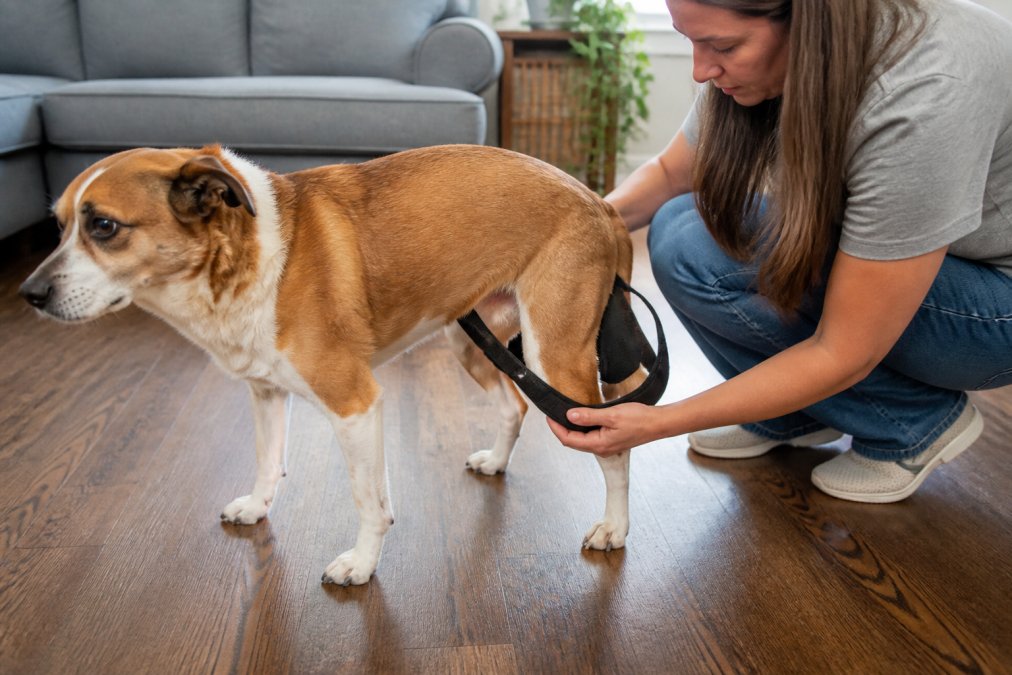
Dog Mobility Harness for Back Legs: What Sets Them Apart
Not every dog requires the same level of support. Understanding the differences between a sling, a full support harness, and a mobility cart is essential to selecting the right tool for your dog's specific condition.
Sling vs. Full Harness vs. Mobility Cart: A Decision Framework
These three categories serve different recovery needs:
Under-Belly Slings are best for dogs recovering from minor procedures, with partial hind-leg weakness, weighing under 50 pounds, or needing short-term support during transitions. Slings provide lift and stabilization but require active participation from the dog, ideal for dogs with functional hind legs that need support, not replacement.
Full Support Harnesses are best for major orthopedic surgery, significant hind-leg weakness, dogs weighing 50-100 pounds, or extended support periods. They distribute weight across chest and hips, providing more stability than slings, though they are bulkier and slower to put on.
Mobility Carts or Wheelchairs are necessary for complete hind-leg paralysis, severe spinal surgery, or dogs over 100 pounds. They are expensive ($800-$3,000+) and require training, but enable dogs with severe deficits to maintain quality of life.
Ask your veterinarian: Can your dog bear weight on the affected leg(s)? How long will support be needed? What is your dog's weight? Is the condition improving or stable/declining? These answers determine whether a sling, full harness, or cart is appropriate.
What Sets Professional Harnesses Apart From Improvised Solutions
A purpose-built harness differs fundamentally from improvised solutions in three key ways:
Design and Weight Distribution: Purpose-built harnesses distribute lift forces across the dog's body rather than concentrating pressure on a single point. Two-piece systems allow independent adjustment of chest and hip support, critical for dogs with asymmetrical weakness.
Adjustability and Fit: Multiple adjustment points accommodate different body shapes and allow tightening as swelling decreases. Breathable materials prevent skin irritation; padded handles reduce caregiver fatigue.
Weight Capacity and Safety: Always choose a harness rated for at least 120% of your dog's body weight to ensure safety and prevent failure.
Material Considerations for Comfort and Durability
Neoprene is water-resistant but can trap heat; padded nylon is breathable and better for warm weather. Seams should be reinforced with double or triple stitching. Buckle-based systems are more durable than Velcro for long-term use.
How to Use a Dog Support Sling Correctly
Position the sling under your dog's belly with handles just behind the front legs and before the hind legs. Lift gently using your legs, not your back. Most dogs need 15-30 seconds of rest between movements during the first two weeks post-op.
Use the sling for every transition: rising, moving between rooms, bathroom breaks, and stairs. Gradually reduce frequency as recovery progresses, but continue for stairs and uneven surfaces until cleared for full activity. Monitor gait for asymmetrical movement, which may indicate pain or swelling.
Choosing the Right Size and Fit for Your Dog
Measure your dog from neck to tail base plus chest circumference, then use manufacturer sizing charts. The fit should be snug enough that you can't slide more than one finger under the straps, but loose enough for comfortable breathing. For dogs between sizes, choose the larger option. Giant breed dogs may need custom solutions, consult your veterinarian for breed-specific recommendations.
| Dog Size | Typical Weight Range | Sling Type | Key Consideration |
|---|---|---|---|
| Small | Under 20 lbs | Standard under-belly | Lightweight materials prevent strain |
| Medium | 20-50 lbs | Standard with padded handles | Balance support with comfort |
| Large | 50-90 lbs | Heavy-duty two-piece | Weight capacity must exceed dog's weight |
| Giant | Over 90 lbs | Custom or semi-custom | Professional fitting recommended |
Post-Surgery Dog Recovery Tips Beyond the Sling
A sling accelerates recovery, but it is one tool among several. The most overlooked element of post-operative care is how to coordinate sling support with physical therapy exercises, the two work synergistically when timed correctly, but conflict when sequenced poorly.
Integrating Physical Therapy With Sling Support
Physical therapy should begin 1-2 weeks post-op, once initial swelling subsides and your veterinarian clears gentle movement. The sling's role shifts during this phase: it stabilizes during transitions and uncontrolled moments, but you remove it for structured rehabilitation exercises. This distinction matters because muscles atrophy rapidly in immobilized dogs, and early, guided movement prevents the compensatory gait patterns that become permanent.
Common post-operative exercises include:
- Passive range-of-motion (PROM): Gently flex and extend the affected leg while your dog lies down, 10-15 repetitions, twice daily. This maintains joint mobility without requiring your dog to bear weight. Begin this within days of surgery if your vet approves.
- Sit-to-stand transitions: With sling support, help your dog rise from a lying position and hold a standing position for 5-10 seconds. Repeat 5-10 times. This engages the surgical leg without full weight-bearing.
- Cavaletti walks: Walk your dog over low poles or raised ground (2-4 inches high) on a leash, without the sling. This forces deliberate leg placement and strengthens muscles. Introduce this around week 3-4 post-op.
- Underwater treadmill therapy: If available through a veterinary rehabilitation clinic, this allows weight-bearing exercise with reduced joint stress. Water supports 50-90% of body weight depending on depth, making it ideal for weeks 4-8 of recovery.
Timing is critical: perform therapy exercises when your dog is alert and pain-free (typically 30-60 minutes after pain medication), not when drowsy or uncomfortable. Most rehabilitation specialists recommend 10-15 minute sessions, 3-4 times weekly, rather than daily sessions that risk overuse.
Activity Restriction: The Non-Negotiable Foundation
Regardless of therapy, restricted activity is non-negotiable during the first 3-4 weeks. Your dog's instinct to play and run directly conflicts with healing. Confine your dog to a small space like a bedroom or bathroom. This prevents the sudden movements, jumping, and twisting that re-injure surgical sites. Many re-injuries occur during unsupervised moments, a dog jumping off a couch or chasing a squirrel can undo weeks of healing in seconds.
Short, controlled leash walks are essential for circulation and muscle maintenance. Aim for 5-10 minute walks, three to four times daily during the first two weeks. These walks should be slow and deliberate; your dog should not pull, jump, or play during this phase. As healing progresses (typically after week 3-4), gradually increase duration and frequency under your veterinarian's guidance. By week 6-8, most dogs tolerate 15-20 minute walks. Never allow off-leash play or unsupervised outdoor time during the first 8 weeks of recovery.
Pain Management and Medication Compliance
Pain management directly impacts recovery speed and your dog's willingness to engage in therapy.
Incision Care and Infection Prevention
Care and Maintenance of Your Dog's Recovery Sling
A well-maintained sling lasts through multiple dogs' recoveries. Hand wash the sling in cool water with mild soap after every few uses, or whenever visible dirt appears. Machine washing can damage padding and straps, the gentle hand-wash approach preserves the sling's support structure.
Frequently Asked Questions
What is a good post-surgery dog sling?
A good dog sling for surgical recovery provides stable hind-end support with padded handles for safe lifting and adjustable straps for a secure fit. The best options feature breathable, non-slip material and ergonomic design that distributes weight evenly. According to veterinary resources, some slings are widely adopted in veterinary hospitals for post-operative rehabilitation because they offer better control and comfort than makeshift towel solutions, especially for larger breeds recovering from ACL, CCL, or hip surgeries.
How do you use a dog sling for back leg support?
Position the sling under your dog's belly, ensuring the padded handle rests comfortably against their hindquarters. Lift gently and gradually, supporting their weight without jerking or straining. Keep your dog's posture neutral, avoid tilting them backward or forward. Use the sling during assisted walks on flat surfaces, helping them navigate stairs or transitions between levels. Always follow your veterinarian's guidance on weight-bearing progression, as overuse can delay healing. Start with short sessions and gradually increase duration as your dog's strength improves.
Can a dog sling help with hip dysplasia recovery?
Yes, a dog sling provides valuable support for dogs recovering from hip dysplasia treatment or surgery. By stabilizing the hind legs and reducing strain on the hip joint, a sling helps prevent muscle atrophy while the joint heals. This support is especially important for senior dogs or larger breeds, where additional weight puts stress on compromised joints. Combine sling use with your veterinarian's prescribed physical therapy to optimize recovery and restore mobility.
What size sling do I need for my large dog?
Choose a sling based on your dog's weight and body length. Measure from the base of your dog's tail to their front chest, then compare to the manufacturer's sizing chart. For large or giant breed dogs, look for slings with higher weight capacity and reinforced handles to safely support heavier loads. Adjustable straps are essential, they allow you to customize the fit as your dog's muscle mass changes during recovery. A properly fitted sling should sit snugly under the belly without gaps or sagging.
0 comments