

Table of Contents
- What Makes Heavy Duty Dog Walking Gear Different
- Heavy Duty Training Collars for Large Dogs
- How to Stop a Dog from Pulling on a Leash
- Tactical Dog Harness for Strong Pullers
- Safety and Visibility Features That Matter
- Materials and Construction Quality Standards
- Maintenance and Care for Long-Lasting Gear
- Frequently Asked Questions
Last Updated: September 22, 2026
What Makes Heavy Duty Dog Walking Gear Different
Heavy duty dog walking gear is engineered to handle the force and pulling power of large dogs and strong pullers using reinforced materials, advanced hardware, and ergonomic designs that withstand sustained pressure without breaking or causing injury.
Heavy duty gear uses braided nylon threads, cowhide leather, or tactical-grade fabrics that meet search and rescue standards, with hardware rated to handle load-bearing stress without deforming, unlike standard nylon webbing, which fails under consistent tension.
According to research from the Center for Pet Safety, only 4 out of 29 tested dog carriers and harnesses passed established safety standards during crash testing. This finding underscores why construction quality matters. A harness that fails under real-world conditions puts your dog at risk.
Quality gear relies on tensile strength, reinforced stitching, and hardware durability, distributing pulling force across multiple anchor points rather than concentrating it on your dog's neck or shoulders.
Heavy Duty Training Collars for Large Dogs
Training collars for large dogs must balance control with comfort. A martingale collar tightens slightly when your dog pulls, providing feedback without choking, the material must withstand repeated adjustment without cutting off airflow.
The Dog Collars And Belt Covers, Heavy-duty Nylon Braided Ropes option from Mac & Ellies pet shop ($6.98) combines a collar and leash into one system. Made from safety climbing rope with 8x braided nylon threads, it meets search and rescue standards and handles dogs over 100 pounds. The 360-degree rotatable hook prevents tangling during training sessions, and the integrated design saves money compared to buying separate pieces.

Cowhide leather offers a different approach. The Cowhide Dog Leash ($7.94) provides durability without the bulk of webbing. Available in multiple lengths for dogs ranging from 30 to 90 kilograms, it works for medium to large breeds.
How to Stop a Dog from Pulling on a Leash
Pulling happens because dogs haven't learned that forward progress stops when they pull. The solution is teaching them that pulling gets no reward, and the gear you use during training directly determines success or failure.
Why Standard Collars Fail During Pulling Training
A collar-based approach concentrates all pulling force on your dog's neck. For dogs over 60 pounds, this creates a biomechanical problem: the dog's neck muscles and trachea absorb force that should be distributed across the chest and shoulders. Research from Hartpury College's canine biomechanics study used electric strain gauges to measure forces on dogs wearing different restraint types. Collars produced peak neck pressure of 15-22 pounds per square inch during a hard pull, while front-clip harnesses distributed the same pulling force across 8-12 square inches of chest surface. The result: dogs wearing collars during training often develop learned avoidance of the collar itself rather than learning not to pull. They pull harder to escape the discomfort, creating a feedback loop that extends training by weeks.
The Harness-Based Protocol for Large Dogs
Use a front-clip harness rather than a collar for this training. A front-clip design (where the leash attaches to a D-ring on the dog's chest, not the back) redirects pulling force to the side, making it mechanically harder for your dog to lunge forward. This isn't a correction, it's a physical redirect that teaches the dog their forward momentum stops when they pull.
Start with a consistent protocol: when your dog pulls, stop walking immediately. Don't move forward until the leash goes slack. This teaches cause and effect: pulling = no progress. Reward walking on a loose leash with treats or verbal praise.
Common Failure Points in Pulling Training
Most owners fail by switching equipment mid-training, which confuses the dog about what behavior produces the reward. Avoid retractable leashes, they reward pulling by allowing forward progress when the dog pulls hardest.
| Training Phase | Duration | Focus | Leash Length | Harness Type |
|---|---|---|---|---|
| Foundation (weeks 1-2) | 15 minutes daily | Stop-and-start technique | 4 feet | Front-clip |
| Building consistency (weeks 3-4) | 20 minutes daily | Variable rewards | 4-6 feet | Front-clip |
| Real-world application (weeks 5+) | Normal walks | Reinforcement | 6 feet | Front-clip or back-clip |
Gear Specifications for Dogs Over 70 Pounds
Nylon webbing at least 1.5 inches wide distributes force without chafing. Braided nylon or cowhide leather handles repeated tension better than single-ply webbing.
Tactical Dog Harness for Strong Pullers
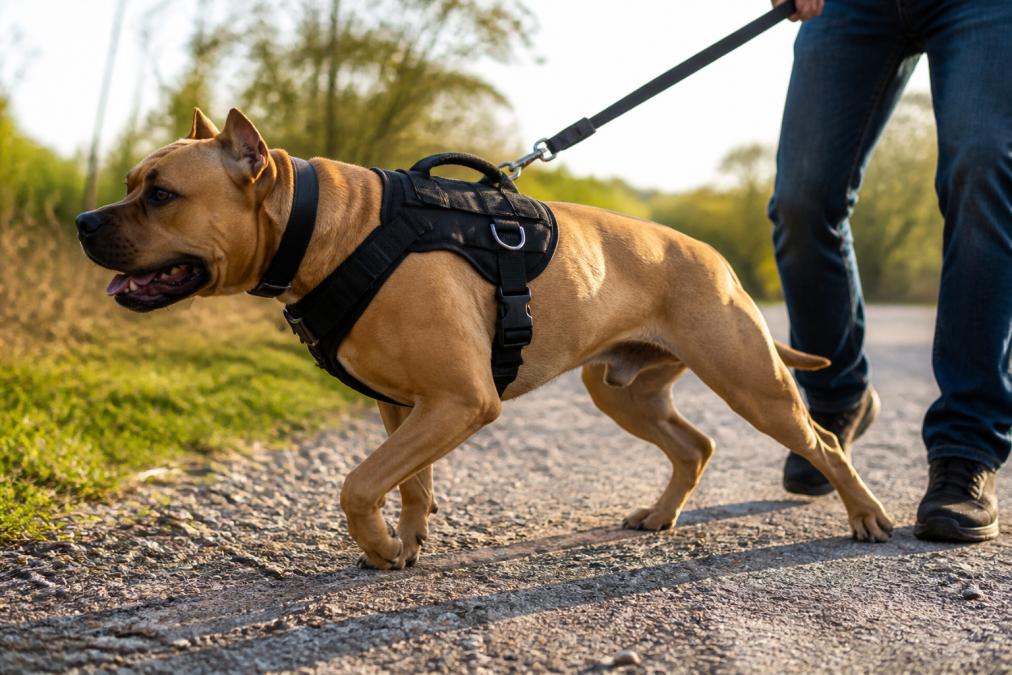
A tactical harness designed for strong pullers uses multiple anchor points, reinforced webbing, and quick-release buckles. The difference between harnesses for 50-pound and 100-pound dogs is load distribution, material thickness, and hardware placement.
Understanding Harness Anchor Points and Load Distribution
Tactical harnesses have front and back D-rings: a front-clip attachment redirects the dog's chest sideways when they pull, making forward lunging mechanically harder; a back-clip attachment allows free movement after training. For dogs over 80 pounds, dual anchor points distribute force across two stress zones, preventing failure at a single seam.
Dog Collars And Belt Covers, Heavy-duty →
Weight-Class Specifications for Harness Selection
Harness design must match your dog's weight and pulling strength.
Material Specifications and Failure Points
Braided nylon with eight-strand braiding is the minimum for dogs over 70 pounds. Cowhide leather softens with use. Oxford cloth (600D) resists mold and dries quickly. Biothane offers waterproof performance.
Hardware Quality and Load Ratings
Stainless steel hardware resists corrosion and maintains shape under load. Metal D-rings should be rated for at least 200 pounds of static load. Quick-release buckles allow emergency removal in under 2 seconds.
Fit and Adjustment for Large Dogs
Safety and Visibility Features That Matter
Low-light walks present real dangers. Your dog becomes invisible to vehicles and cyclists. Reflective trim and LED lights solve this problem.
The Pet Raincoat Reflective Night Walk ($15.99) from Mac & Ellies pet shop combines weather protection with high-visibility design. The polyester material sheds water, and the reflective elements catch vehicle headlights from up to 100 feet away. Available in sizes S through L, it fits most dogs.

The Dual Headed Pet Leashes with Flashlight ($21.14) addresses visibility differently. Built-in LED lights illuminate the ground ahead during evening walks, and high-strength reflective nylon webbing makes your dog visible to traffic. The dual-headed design suits owners with two dogs, with independent rope controls to prevent tangling.
The Pet Dog Chest Strap Sign DO NOT PET Sticker ($1.72) serves dogs with anxiety or medical conditions. The PU material holds text clearly, and most owners use two pieces (front and back) for maximum visibility. This signals to strangers that your dog shouldn't be approached, reducing stress during walks.
According to Reddit's r/dogs community data, increased adoption of LED-integrated vests and collars for low-light environments reflects growing awareness of nighttime walking safety. Reflective trim alone isn't enough on completely dark trails.
Materials and Construction Quality Standards
Braided nylon with eight-strand braiding meets durability standards for heavy duty applications. Cowhide leather softens with use but requires maintenance. Oxford cloth (600D) resists mold and dries quickly. Biothane offers waterproof performance. Stainless steel hardware resists corrosion and maintains shape; plastic hardware deforms under sustained pressure.
Maintenance and Care for Long-Lasting Gear
Proper maintenance extends the life of your heavy duty gear by years. Neglect shortens it dramatically.
For braided nylon and webbing: rinse after muddy walks and air dry completely.
Frequently Asked Questions
What is the most durable material for heavy duty dog walking gear?
Heavy duty dog walking gear typically uses 8x braided nylon threads, reinforced webbed nylon, or cowhide leather for maximum tensile strength. Braided nylon meets search and rescue standards and resists abrasion. Cowhide offers durability for dogs weighing 30-90 pounds. Webbed nylon with reinforced stitching prevents fraying and withstands constant pulling.
How do I choose a heavy duty training collar for a large dog?
Select a collar with 8x braided nylon construction and a 360-degree rotatable hook for freedom of movement. Ensure the hardware matches your dog's weight, different sizes feature different hardware thickness. For dogs over 100 pounds, climbing rope construction provides unbeatable strength. Mac & Ellies offers braided martingale collars starting at $6.98 that handle extra-large dogs without breaking. Measure your dog's neck and check weight specifications before purchasing.
What gear helps stop a dog from pulling on a leash?
A tactical dog harness distributes pulling force across the chest and back rather than concentrating it on the neck, reducing strain and giving you better control. Chest straps made from Oxford cloth with EVA padding provide comfort and breathing room. The 360-degree rotatable hook design prevents twisting and tangling during training. Dual-headed leashes with independent controls work well for managing multiple dogs. Combine proper harness fit with consistent training for best results.
Are reflective and high-visibility features really necessary?
Yes. Reflective trim and LED-integrated gear significantly improve safety during low-light walks. High-visibility materials make your dog visible to vehicles and other pedestrians at dawn, dusk, and night. Mac & Ellies Pet Raincoat includes reflective trim for nighttime visibility, and the Dual Headed Pet Leashes feature LED lights and reflective nylon webbing.
How often should I inspect and maintain heavy duty dog walking gear?
Inspect your gear weekly for signs of wear, fraying, or hardware damage. Clean nylon and webbed gear with mild soap and water, then air-dry completely. Cowhide leashes benefit from leather conditioner monthly. Check all clips, buckles, and attachment points before each walk. Replace gear immediately if you notice tears, loose stitching, or corroded hardware. Proper maintenance extends the life of your investment and keeps your dog safe.
0 comments