

Table of Contents
- Why Dogs Beg at the Feeder
- Establish a Consistent Feeding Schedule
- Automatic Pet Feeder Training: Teaching Your Dog to Wait
- Address Dog Food Guarding Behavior
- Use Physical Barriers and Environmental Management
- Smart Pet Feeders With Video Interaction: Remote Monitoring and Training
- Replace Begging With Positive Behaviors
- Maintain Consistency Across Your Household
- Frequently Asked Questions
Last Updated: September 27, 2026
Why Dogs Beg at the Feeder
Understanding how to stop dog from begging at feeder starts with recognizing that dogs beg because the behavior is reinforced by human interaction. When your dog stares, whines, or barks near the bowl, you naturally look, talk, or give scraps, all rewards from your dog's perspective.
This is operant conditioning in action. Your dog learns that the behavior produces a reward. The reward doesn't even need to be food. Sometimes attention alone is enough. According to research on canine begging strategies from the National Center for Biotechnology Information, these behaviors are reinforced through consistent environmental management failures, meaning the household isn't preventing the opportunity for begging to happen in the first place.
Inconsistency is the real problem. When one family member ignores begging but another gives in, your dog learns persistence pays off, making extinction nearly impossible.
Understanding why your dog begs is essential. Without addressing inadvertent reinforcement, no training technique will stick.
Establish a Consistent Feeding Schedule
A consistent routine is your foundation. Dogs fed immediately before human mealtimes demonstrate calmer behavior and a statistically lower frequency of begging compared to those fed at other times, according to the Dogspotting Society community survey.
A full stomach reduces begging motivation. Feed at the same time daily, ideally 30 minutes to an hour before your family eats, creating a predictable rhythm.
Set a feeding schedule and stick to it:
- Feed at the same time each morning
- Feed at the same time each evening
- Keep mealtimes separate from your own eating times
- Use a timer if you need the reminder
Automatic Pet Feeder Training: Teaching Your Dog to Wait
An automatic pet feeder removes the human element from feeding, eliminating a major begging trigger since your dog doesn't see food preparation.
The training process typically unfolds like this:
- Week 1: Let your dog see the feeder. No food yet.
- Week 2: Feed one meal from the feeder while you're nearby.
- Week 3: Activate the feeder with you present. Reward calm behavior.
- Week 4: Activate the feeder and leave the room briefly.
Address Dog Food Guarding Behavior
Begging intensity can signal medical issues, not just behavioral problems. Rule out health conditions that increase appetite before assuming attention-seeking behavior.
Medical causes of excessive begging:
- Diabetes mellitus, Dogs with diabetes experience constant hunger and thirst. They beg persistently because their bodies cannot regulate blood glucose properly. If your dog is also drinking more water, urinating more frequently, or losing weight despite eating more, consult your veterinarian immediately.
- Hyperthyroidism, Overactive thyroid function increases metabolism and appetite. Affected dogs beg constantly and may seem restless or anxious around food.
- Parasitic infections, Intestinal parasites compete for nutrients, leaving your dog perpetually hungry. Begging combined with diarrhea, vomiting, or a dull coat warrants a fecal exam.
- Malabsorption disorders, Conditions like exocrine pancreatic insufficiency (EPI) prevent proper nutrient absorption. Your dog eats but doesn't feel satisfied, driving relentless begging.
- Cushing's syndrome, This endocrine disorder increases appetite and can cause behavioral changes including food-focused anxiety.
Watch for these warning signs of true food guarding:
- Stiff body posture or tension over the bowl
- Eating too fast without chewing
- Growling, snarling, or showing teeth near food
- Blocking other pets from the feeding area
- Eating and then returning to guard an empty bowl
Use Physical Barriers and Environmental Management
The simplest solution is often most effective: prevent begging by using physical barriers like baby gates or crates to remove your dog from the room during mealtimes.
Set up your feeding environment this way:
- Use a baby gate to keep your dog out of the dining area
- Crate your dog during family meals if needed
- Feed your dog in a separate room from where you eat
- Keep human food out of reach and out of sight
Smart Pet Feeders With Video Interaction: Remote Monitoring and Training
Smart pet feeders with video interaction allow busy professionals to monitor and train their dog remotely while maintaining feeding consistency.
These feeders allow you to:
- Schedule meals at precise times from your phone
- Watch your dog eat via live video feed
- Dispense treats remotely to reinforce calm behavior
- Maintain feeding consistency even when you're away
Replace Begging With Positive Behaviors
The most effective long-term strategy is teaching your dog an alternative behavior to begging. Teach them to lie on a mat or stay in a "down" position away from the dining area, replacement behavior training where your dog learns what TO do instead of what not to do.

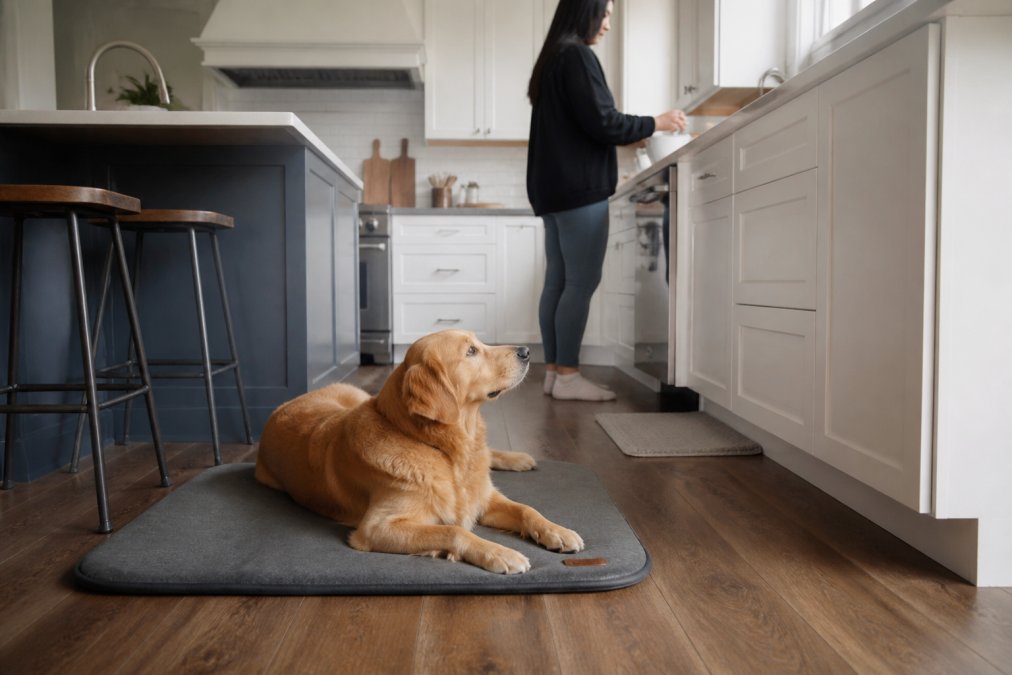
The 'place' command training protocol:
Week 1-2: Foundation (5-10 minute sessions, 2-3 times daily)
- Choose a specific mat, bed, or rug as your dog's "place."
- Point to the mat and say "place" in a clear, upbeat tone.
- Lure your dog onto the mat with a high-value treat (small pieces of chicken, cheese, or commercial training treats).
- The moment all four paws touch the mat, mark the behavior with "yes!" or a clicker, then immediately reward with the treat.
- Repeat 10-15 times per session. Your dog should begin moving toward the mat when they hear "place."
- Gradually reduce how much you lure; let your dog figure out the behavior.
Week 3-4: Duration and distance (10-15 minute sessions, 2-3 times daily)
- Once your dog reliably goes to the mat, ask them to stay there for 3-5 seconds before rewarding.
- Increase duration by 2-3 seconds every few repetitions: 5 seconds, 8 seconds, 10 seconds, 15 seconds, 20 seconds.
- Reward every successful hold. Use a treat or verbal praise ("good place!").
- Begin stepping away from the mat while your dog stays. Start with one step back, then two, then three. Return to reward before your dog breaks position.
- If your dog leaves the mat early, calmly say "oops," reset, and try again with shorter duration.
Week 5-6: Adding real-world distractions (15-20 minute sessions, 1-2 times daily)
- Practice "place" while you're preparing food in the kitchen (but not eating yet).
- Start with your dog on the mat 8-10 feet away from where you're working.
- Gradually move closer to your dining area over multiple sessions.
- Practice during non-mealtime hours first. Your dog should be solid on the command before you use it during actual family meals.
- Reward frequently, every 10-15 seconds at first, to keep engagement high.
Week 7+: Mealtime integration
- Send your dog to their mat 5 minutes before you sit down to eat.
- Reward them for staying on the mat while you eat. Use a puzzle toy or long-lasting chew (a bully stick, Kong with peanut butter, or lick mat) to keep them occupied.
- Reward calm behavior on the mat every 2-3 minutes during your meal. This teaches your dog that staying on the mat produces good outcomes.
- Gradually reduce treat frequency as the behavior becomes routine, but continue occasional rewards to maintain motivation.
- If your dog leaves the mat, calmly redirect them back without drama. Do not reward them for leaving.
Troubleshooting common issues:
- Your dog won't stay on the mat, You're increasing duration too fast. Go back to 3-5 second holds and build more slowly. Some dogs need 4-6 weeks to reliably hold a 30-second "place."
- Your dog leaves the mat when you move away, Practice distance in shorter increments. If your dog breaks at 5 feet away, stay at 3 feet for another week.
- Your dog leaves the mat during meals, The distraction is too high. Practice "place" during non-mealtime hours for another 1-2 weeks before using it during actual eating.
- Your dog gets bored on the mat, Pair the mat with a puzzle toy, frozen Kong, or snuffle mat filled with treats. The mat becomes a place where good things happen, not a place of deprivation.
Why 'place' training works:
Maintain Consistency Across Your Household
Most attempts fail due to inconsistency: one family member enforces rules while another breaks them. Your dog learns begging works with some people.
| Strategy | Best For | Time to Results |
|---|---|---|
| Consistent feeding schedule | All dogs | 2-4 weeks |
| Physical barriers (gates/crates) | High-energy dogs | Immediate |
| Replacement behavior training | Dogs that need structure | 4-8 weeks |
| Automatic feeders | Busy households | 2-3 weeks |
| Video-enabled feeders | Remote monitoring needs | 2-3 weeks |
Frequently Asked Questions
Why does my dog stare at the automatic feeder?
Dogs stare at feeders because they've learned that the feeder delivers food, creating an attention-seeking behavior. According to research from the National Center for Biotechnology Information (NCBI), specific begging behaviors are often reinforced by human interaction and environmental cues. Your dog associates the feeder with mealtime and may be hoping to trigger feeding through eye contact or proximity. Breaking this pattern requires consistent training and feeding schedules rather than responding to the staring with attention or food.
How can automatic pet feeder training help stop begging behavior?
Automatic pet feeder training teaches your dog that meals arrive on a schedule, not through begging. By feeding your dog immediately before your own mealtimes, you reduce the motivation to beg during your eating. Research from the Dogspotting Society found that dogs fed before human mealtimes show statistically lower begging frequency. Automatic feeders remove the human element from feeding, so your dog learns the feeder, not their behavior, controls meal delivery. Pair this with replacement behaviors like down-stay commands for maximum effectiveness.
What should I do if my dog shows food guarding behavior at the feeder?
Food guarding requires separate intervention from begging. Never punish guarding, as this escalates the behavior. Instead, use counter-conditioning: reward your dog for calm behavior around the feeder when it's empty, gradually introducing your presence during feeding. If guarding is severe, consult a certified professional trainer. Avoid hand-feeding from the bowl or reaching near your dog during meals. Environmental management, feeding your dog in a separate room or using a baby gate, can prevent triggering the guarding response while you train replacement behaviors.
How long does it take to stop a dog from begging at the feeder?
Timeline depends on consistency and your dog's age. Puppies typically respond within 2-4 weeks; adult dogs may take 4-8 weeks. The critical factor is household consistency, if family members occasionally reward begging, the behavior takes significantly longer to extinguish. Research shows that intermittent reinforcement (rewarding sometimes, not always) actually strengthens begging. Expect an extinction burst (increased begging intensity) around week 2-3 before improvement. Using tools like puzzle toys and smart feeders with video monitoring helps maintain consistency when you're away.
0 comments