

Table of Contents
- Why Healthy Weight Matters for Dogs
- Recognizing Overweight and Obese Dogs
- How Much to Feed an Overweight Dog
- Automatic Dog Feeder Portion Control: Setup and Calibration
- Dog Feeding Schedule for Weight Management
- Slow Feeder Bowl for Dogs: Benefits and Selection
- Reducing Treats and Table Scraps
- Monitoring Weight Loss and When to Seek Veterinary Help
- Frequently Asked Questions
Last Updated: October 11, 2026
Why Healthy Weight Matters for Dogs
Maintaining a healthy weight is one of the most important things you can do for your dog's long-term health and quality of life. According to Association for Pet Obesity Prevention research, in 2022, 59% of dogs were classified as overweight or having obesity.
Overweight dogs face serious health risks including joint problems, diabetes, heart disease, and shortened lifespans. Extra weight reduces mobility and quality of life.
The good news: preventing dog obesity with feeders and proper portion control is entirely within your control. When you take action early, you can help your dog live a longer, healthier, more active life.
Recognizing Overweight and Obese Dogs
Visual inspection and hands-on assessment reveal whether your dog needs to lose weight.
A dog at a healthy weight should have:
- Visible ribs you can feel (but not see prominently)
- A clear waist when viewed from above
- A tucked abdomen when viewed from the side
- Energy and mobility without excessive panting
If ribs disappear under fat or there's no visible waist, your dog is likely overweight. Obese dogs struggle with walking, breathing, and play.
Your veterinarian can assess your dog's body condition score using a standard 1-9 scale. Scores of 6-9 indicate overweight or obesity. This professional assessment helps you establish a baseline and set realistic weight-loss goals.
How Much to Feed an Overweight Dog
Daily calorie needs depend on ideal weight, age, activity level, and food calorie content.
Calculate daily calories based on ideal weight: 25-30 calories per pound for moderately active dogs. A 50-pound dog needs roughly 1,250-1,500 calories daily.
For weight loss, reduce calories by 10-25% below maintenance. Feed a high-protein, low-calorie diet to preserve muscle while fat decreases.
Your veterinarian can recommend a specific weight-loss diet or help you calculate portions for your current food. Never guess at portions. Measuring is essential.
Automatic Dog Feeder Portion Control: Setup and Calibration
An automatic feeder removes guesswork by delivering exact portions at scheduled times. However, calibration and verification are essential to ensure accurate dispensing.
Measuring Food Accurately
Accurate measurement is the foundation of preventing dog obesity with feeders. Weigh your dog's daily allowance using a kitchen scale before setup.
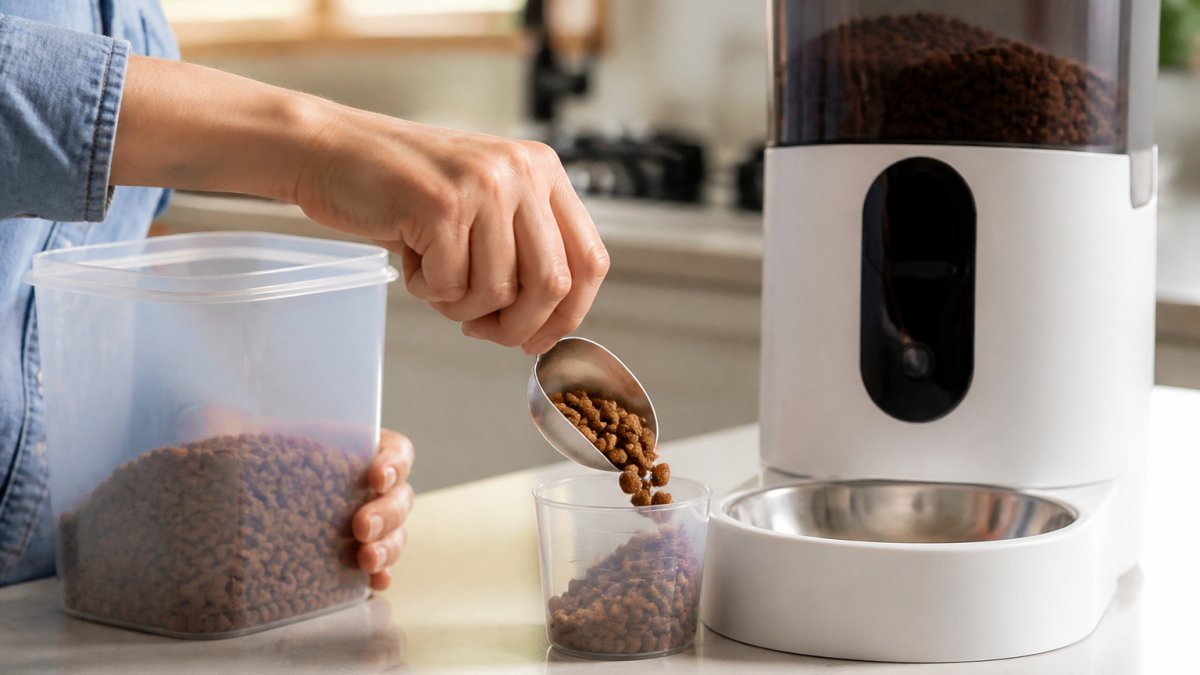
Use a kitchen scale for precision. Weigh the exact amount your veterinarian recommends and record it for reference.
Most automatic feeders use cups or grams as their unit of measurement.
Testing Feeder Accuracy Against Actual Dispensing
Kibble size, moisture content, and feeder wear affect dispensing accuracy. Test your feeder before relying on it for weight management.
How to calibrate your feeder:
- Program the feeder to dispense one meal portion (e.g., 0.75 cups or 150 grams)
- Place an empty bowl on a kitchen scale beneath the feeder chute
- Activate the feeder and let it dispense one full portion
- Weigh the kibble immediately and record the result
- Repeat this test three times to check consistency
- Compare the actual weight to the programmed amount
Adjust settings if the feeder consistently dispenses 10% more or less than programmed. Large-kibble foods dispense less accurately than small-kibble foods, so re-test when switching foods.
Configuring Portion Sizes
Program portions based on your veterinarian's recommendation and verify against calibration tests. Monitor weight weekly; if loss stalls after 4-6 weeks, reduce portions by 10%. Consistency in correct portions drives steady weight loss.
Multi-Pet Households and Food Stealing
In multi-dog homes, one dog often eats another's portion. Automatic feeders solve this by controlling access.
Strategies for multi-pet feeding:
- Separate feeding locations: Place each dog's feeder in a different room and close the door during meals.
- Staggered schedules: Program feeders to dispense at slightly different times to reduce competition.
- Microchip-activated feeders: These recognize individual dogs and open only for the intended dog, most reliable but more expensive.
- Gated feeders: Use baby gates to create feeding zones accessible only to the intended dog.
Without separation, even correctly portioned feeders cannot prevent weight gain if a second dog eats the first dog's meal.
Dog Feeding Schedule for Weight Management
A structured feeding schedule prevents constant snacking and regulates metabolism. Two meals per day stabilize blood sugar, prevent begging, enable intake tracking, and support digestion.
Set consistent feeding times and offer only water between meals. Avoid free-feeding, which encourages overeating. Scheduled meals with automatic feeders remove temptation entirely.
For busy professionals, automatic feeders with scheduling ensure consistent routines even when away. At Mac & Ellies pet shop, we offer feeders with video-interactive capabilities for remote monitoring.
Slow Feeder Bowl for Dogs: Benefits and Selection
Slow feeder bowls slow eating speed, improving digestive health and meal satisfaction, but they don't reduce calories.
Pet Slow Feeder Toy Puzzle Press-to-Feed Dispenser →
What Slow Feeders Actually Do
Slow feeders work by creating physical barriers or puzzles that require effort to access kibble. They space food across a wider surface area or force your dog to work for each bite. This slows eating pace, which offers real benefits:
- Reduces bloating and gas: Dogs that eat too quickly swallow air, leading to gastric distension and discomfort. Slower eating minimizes air intake.
- Improves satiety signals: Your dog's brain takes 15-20 minutes to register fullness. A slow feeder extends mealtime, giving satiety hormones time to work. This can reduce the urge to beg for more food immediately after eating.
- Decreases vomiting: Some dogs regurgitate kibble when they eat too fast. Slowing pace reduces this risk.
- Provides mental enrichment: The effort required to access kibble engages your dog's problem-solving instincts, making mealtime more stimulating.
Slow feeders do NOT reduce calories. If a slow feeder takes your dog 20 minutes instead of 2 minutes to eat the same 1-cup portion, your dog still consumes the same calories. Slow feeders are a tool for meal satisfaction and digestive health, not calorie reduction. For weight loss, portion control remains the primary lever.
Slow Feeders Versus Portion-Control Feeders
Understanding the difference between these two feeder types is critical for choosing the right tool.
Slow feeders (passive):
- Slow eating pace
- Do not limit portion size
- Rely on you to measure and place the correct amount in the bowl
- Best for dogs that eat too fast but are at a healthy weight, or as a supplement to portion control
- Examples: flower-core designs, maze-pattern bowls, ridge-and-valley surfaces
Portion-control feeders (active):
- Dispense a pre-set amount automatically
- Control total daily intake regardless of eating speed
- Require calibration and monitoring
- Best for weight loss or weight maintenance in dogs prone to overeating
- Examples: automatic timed feeders, gravity feeders with portion gates, measured-cup dispensers
Many dogs benefit from combining both: a portion-control feeder that dispenses the correct amount, paired with a slow-feeder bowl design to extend mealtime and improve satiety. This addresses both calorie intake (the primary driver of weight loss) and eating behavior (a secondary factor in satisfaction).
Selecting a Slow Feeder for Your Dog
Slow feeders come in various designs and difficulty levels. Match the feeder to your dog's problem-solving ability and eating style.
Design types and their effects:
- Flower-core or petal designs: Ridges and petals force kibble into crevices, requiring your dog to use their tongue and lips to extract food. These slow eating moderately and work well for dogs new to slow feeders.
- Maze or ridge patterns: Raised patterns across the bowl floor create channels and barriers. Kibble sits in grooves, and your dog must navigate the pattern to access each bite. These slow eating more significantly.
- Windmill or spiral designs: Kibble sits in a spiral or rotating pattern. Your dog must push or manipulate the bowl to access food. These are more engaging and work well for dogs that enjoy interactive play during meals.
- Puzzle or compartment feeders: Food is divided into separate sections or hidden under flaps. Your dog must solve the puzzle to access each compartment. These provide the most mental enrichment but take longer to clean.
Matching difficulty to your dog:
- Beginner: Simple ridge or petal designs. Your dog should be able to access kibble within 5-10 minutes without frustration.
- Intermediate: Maze or spiral designs. Your dog can problem-solve but still finishes within 10-15 minutes.
- Advanced: Puzzle or compartment feeders. Your dog enjoys complex challenges and can spend 15-20 minutes on a single meal.
If a feeder is too difficult, your dog may become frustrated and refuse to eat. If it's too easy, it won't slow eating significantly. Start with a simpler design and upgrade if your dog masters it quickly.
Cleaning and Maintenance
Slow feeders with intricate designs (maze, puzzle, compartment) trap kibble dust and moisture in crevices. Clean thoroughly after each meal to prevent mold and bacterial growth. Most slow feeders are dishwasher-safe, but hand-washing with a brush ensures all grooves are clean. Inspect regularly for cracks or wear that could harbor bacteria or create sharp edges.
Reducing Treats and Table Scraps
Treats and table scraps are a major hidden source of calories. A single treat can represent 5-10% of a dog's daily calorie allowance.
Research shows studies on canine obesity factors that table scraps and snacks are associated with overweight and obesity in dogs.
Establish clear rules:
- No table scraps during meals or cooking
- Limit treats to 10% of daily calories maximum
- Use low-calorie options like carrots or green beans
- Count treat calories toward the daily total
If multiple people in your household feed your dog, post the daily calorie allowance and treat guidelines visibly. Inconsistent feeding is a major obstacle to weight loss.
For multi-pet households where food stealing is common, an automatic feeder prevents one dog from eating another's portion.
Monitoring Weight Loss and When to Seek Veterinary Help
Track your dog's weight weekly using the same scale at the same time of day. Record results in a notebook or phone app.
A dog weighing 80 pounds might lose 0.8-1.6 pounds weekly. This seems slow, but it's sustainable and preserves muscle mass.
After 4-6 weeks, assess progress:
- Is your dog losing weight steadily?
- Does your dog seem hungry or lethargic?
- Have you noticed improvements in mobility or energy?
Some dogs have medical conditions, thyroid problems, metabolic disorders, that complicate weight loss. A veterinarian can rule these out and provide a customized plan.
Preventing dog obesity with feeders is a practical, sustainable approach to your dog's health. Automatic feeders remove guesswork, slow feeders improve digestion, and scheduled meals create structure.
Frequently Asked Questions
Can an automatic feeder help prevent dog obesity?
Yes, automatic feeders support obesity prevention by ensuring consistent portion control and scheduled meals rather than free-feeding. According to veterinary guidance, measured portions and consistent mealtimes are key strategies for weight management. Automatic feeders eliminate guesswork by dispensing exact amounts at set times, preventing overfeeding. However, feeders work best as part of a comprehensive approach that includes appropriate food selection, exercise, and limiting treats. A 2024 study found that veterinary weight-management plans work best when combined with proper feeding practices and owner engagement.
How many times a day should an overweight dog eat?
Most veterinarians recommend feeding an overweight dog two to three times daily in measured portions rather than one large meal or free-feeding. Divided meals help maintain steady energy levels and reduce hunger between feedings. A dog feeding schedule for weight management should align with the dog's ideal weight, age, and activity level. Consistent mealtimes also make it easier to monitor intake and adjust portions based on progress. Consult your veterinarian about the ideal feeding frequency for your dog's specific situation.
Can slow feeder bowls help dogs lose weight?
Slow feeder bowls can support weight management by slowing eating pace and increasing meal duration, which promotes satiety and reduces the urge to overeat. A slow feeder bowl for dogs creates natural obstacles that require the dog to work around ridges or patterns to access kibble, mimicking natural foraging behavior. This approach reduces choking risk and aids digestion. However, slow feeders work best when combined with portion control, slowing intake without limiting total calories has limited weight-loss impact. They are most effective as part of a complete feeding strategy that includes measured portions and consistent schedules.
What should I do if my dog keeps begging after meals?
Persistent begging after meals often signals hunger due to inadequate portions or inappropriate treats between meals. First, verify that you're feeding the correct amount for your dog's ideal weight using a food scale or measuring cup. Review treats and table scraps, which account for a significant portion of daily calorie intake. Establish a strict feeding schedule and avoid feeding outside mealtimes. Redirect begging behavior with exercise or a puzzle toy instead of food. If begging persists despite appropriate portions, consult your veterinarian, it may indicate a medical issue or require adjustments to your dog's diet or feeding routine.
0 comments