

Table of Contents
- What Makes a Reliable Automatic Dog Feeder
- Automatic Dog Feeders with Camera: Remote Monitoring and Peace of Mind
- Automatic Dog Feeder for Large Dogs: Capacity and Durability
- How to Choose an Automatic Dog Feeder: Selection Criteria That Matter
- Best Automatic Dog Feeders: Top Picks and Comparison
- Automatic Dog Feeder for Wet Food: What You Need to Know
- Frequently Asked Questions
Last Updated: October 17, 2026
What Makes a Reliable Automatic Dog Feeder
A reliable automatic dog feeder is a device that dispenses measured portions of kibble on a preset schedule, eliminating the need for manual feeding throughout the day. According to Consumer Reports testing of automatic dog feeders, dependable portion delivery matters far more than smart features alone. The Pawsync Smart Pet Feeder's scale proved most accurate at weighing dispensed portions during independent testing, which underscores why precision in dispensing consistency should be your first evaluation criterion.
What separates a trustworthy feeder from a gimmicky one comes down to three factors: mechanical reliability, accurate portion control, and consistent food storage. Wi-Fi and cameras don't guarantee reliability. A feeder that jams on certain kibble sizes or drifts in portion accuracy will frustrate you far more than a no-frills model that simply works every time.
At Mac & Ellies pet shop, we recommend evaluating automatic dog feeders on real-world performance rather than marketing claims: look for minimal food jam incidents, accurate weight-based dispensing, and straightforward maintenance.
Automatic Dog Feeders with Camera: Remote Monitoring and Peace of Mind
Video-enabled automatic dog feeders let you monitor your pet and dispense food remotely while you're away. This addresses a real anxiety point for professionals who travel or work long hours: checking on your dog and adjusting feeding in real time without relying on a pet sitter or neighbor.
The New York Times Wirecutter's 2026 automatic pet feeder testing highlighted camera and app features as standard in top-ranked models, alongside portion-control capabilities. Good Housekeeping named the Petlibro Automatic Feeder with Camera as its best overall pick, and Petful described its top recommendation as pairing portioning with live video access. These aren't luxury extras anymore, they're baseline expectations for mid-range feeders.
Mac & Ellies pet shop carries the Pet Feeder For Cats 6L Automatic Feed Dispenser With Camera at $73.96, offering Wi-Fi connectivity, dual-port feeding, and wide-angle video monitoring through the Tuya app. The 6L capacity suits multi-pet households or extended work days.
Camera features prove most valuable with separation anxiety: you can check on your dog visually without triggering departure stress and dispense a portion remotely if feeding time arrives unexpectedly. But the camera supplements daily check-ins rather than replacing them. For severe separation anxiety, a feeder alone won't solve it; you'll need behavioral work alongside the tech.
Automatic Dog Feeder for Large Dogs: Capacity and Durability
Large dogs break automatic feeders in ways small dogs never do. A 90-pound Labrador retriever eats roughly 3 to 4 cups of kibble a day, noses the dispenser hard enough to tip a lightweight hopper, and may guard the bowl.
Capacity math that holds up. Standard feeders hold 3 to 5 liters, fine for a 20-pound dog but forcing refills every two to three days for a 70-plus-pound breed. A 6L hopper typically covers about a week for a large dog eating 3 to 4 cups daily.
Where large-dog durability actually matters. The failure points are the impeller, the auger or dispensing gate, and the hopper latch, not the outer shell. Look for sealed motors, reinforced impeller assemblies, and metal or thick-walled hoppers rather than thin plastic that cracks under a dog's weight or pawing.
Stability and tipping. Large dogs push, so a wide, low center of gravity and a non-slip base matter more than a decorative housing.
Fast eaters and food-motivated dogs. Large breeds are often fast eaters who can outpace a slow dispenser or paw food out of an open chute. Enclosed dispensing and a covered bowl reduce scavenging and food stealing in multi-dog homes. If your dog works at the lid, a paw-resistant latch is not a luxury.
What to verify before buying for a large dog:
- Hopper capacity of 6L or more, or a two-feeder setup for multi-dog homes.
- Sealed motor and reinforced impeller, not just a sturdy-looking shell.
- Non-slip base and a bowl that locks in place.
How to Choose an Automatic Dog Feeder: Selection Criteria That Matter
Start by defining your primary constraint: budget, convenience, monitoring capability, or a specific feeding need. These rarely align, so rank them honestly. A $150 camera-equipped feeder won't help if you need wet-food handling, and a Wi-Fi-connected feeder won't help if your home Wi-Fi is unreliable.
Next, evaluate hopper capacity against your dog's daily intake to calculate refill frequency. If you refill more than twice weekly, the feeder isn't saving you meaningful time. Aim for 6L+ for large dogs; 3-4L suffices for small dogs.
Third, test portion accuracy. Research whether the model uses weight-based or cup-based dispensing. Weight-based is more accurate and adjusts for kibble density variations. Cup-based dispensing is less precise but simpler mechanically. According to MDPI research on smart pet feeder design, IoT-enabled feeders can identify individual pets and dispense portions based on weight for personalized feeding, though this feature remains uncommon in consumer models.
Fourth, assess the dispensing mechanism for your kibble size. Contact the manufacturer or read verified reviews from owners using your exact kibble brand. Food jam is the #1 complaint about automatic feeders, and it's almost always a kibble-size mismatch, not a feeder defect.
Finally, evaluate backup systems: battery backup, offline function, and power-outage behavior matter more than marketing claims about smart features.
| Criteria | What to Look For | Why It Matters |
|---|---|---|
| Hopper Capacity | 6L+ for large dogs, 3-4L for small dogs | Determines refill frequency and convenience |
| Portion Accuracy | Weight-based over cup-based | Prevents overfeeding and ensures consistency |
| Dispensing Mechanism | Sealed impeller, reinforced assembly | Reduces jamming and extends feeder lifespan |
| Backup Power | Battery backup or manual override | Ensures feeding continues during outages |
| App Reliability | Reviews mentioning app stability | Determines remote-feeding usability |
| Warranty | 1-2 year manufacturer coverage | Signals product confidence and protection |
Best Automatic Dog Feeders: Top Picks and Comparison
Automatic Pet Feeder - Smart Food and Water Feeding Station
Mac & Ellies pet shop's Automatic Pet Feeder at $126.12 combines food and water access in one integrated station, simplifying your pet's feeding area. It's the best overall choice for owners seeking a practical, dual-function solution for eating and drinking routines.
Automatic Pet Feeder – Smart Food and Water Feeding Station for Pets →
The design keeps food and water compartments organized in one location, reducing clutter and making intake easier to monitor. It supports both cats and dogs, though capacity varies by configuration, and the USB power cable and straightforward setup mean you're dispensing food within minutes.
What works: The dual-compartment design eliminates separate water and food bowls scattered around your home, and the consistent schedule removes guesswork about whether your dog ate when you travel for work.
What doesn't: It prioritizes simplicity over advanced features, no Wi-Fi or video monitoring, just mechanical scheduling.
Best for: Pet owners who value straightforward reliability and convenient feeding setup over smart features. Works well for professionals with predictable daily schedules.
Pet Feeder For Cats 6L Automatic Feed Dispenser With Camera
The Pet Feeder For Cats 6L Automatic Feed Dispenser With Camera at $73.96 delivers the most practical blend of camera monitoring and reliable portion control for anxious owners and remote workers. The 6L capacity handles multiple days of feeding for most dogs, and the dual-port design accommodates different food types or multi-pet households.
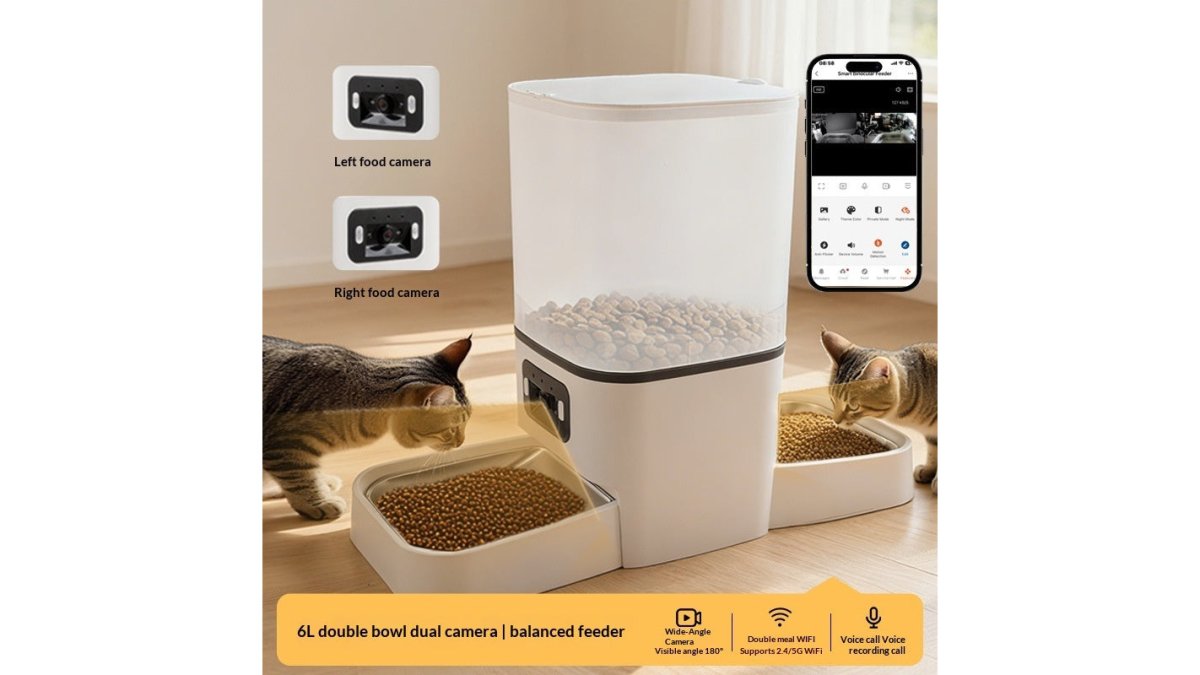
The Tuya app lets you monitor your dog live, dispense portions remotely, and set flexible schedules from your phone, while the wide-angle binocular camera gives clear visibility of eating behavior and wellbeing.

What works: The camera genuinely reduces separation anxiety for owners who travel, you can check on your dog without triggering departure cues. The 6L capacity means fewer refills for large dogs, and Wi-Fi allows remote feeding adjustments when schedules change.
What doesn't: App stability depends on your home Wi-Fi; if the connection drops, the feeder reverts to manual mode.
Best for: Busy professionals who travel 3-4 days weekly and want video monitoring combined with reliable portion control. Ideal for multi-pet households needing 6L+ capacity.
Automatic Dog Feeder for Wet Food: What You Need to Know
Wet food and automatic feeders are a hard pairing, and most guides wave it away with "wet food jams." The real issues are food safety and freshness: wet food left at room temperature spoils quickly, attracts pests, and creates buildup that jams the next cycle.
Why standard feeders fail on wet food. Dry-kibble feeders assume uniform particle size and gravity-assisted flow. Wet food clumps, sticks to hopper walls, and coats the auger or gate, causing partial portions, missed feeds, and cleaning after nearly every use. Most consumer automatic feeders are engineered for dry food only, and the manual usually says so.
The freshness problem. Even feeders marketed for wet or semi-moist food typically hold a single meal and rely on a sealed or chilled compartment. Once the seal breaks or the cooling pack warms, wet food sits in the temperature danger zone.
Cleaning and hygiene. Any feeder that touches wet food needs removable, dishwasher-safe parts and a sanitizable bowl. Choose stainless steel over plastic, which scratches and harbors residue. If the hopper or chute can't be fully removed and washed, wet food is the wrong use case for that model.
What actually works for wet-food dogs:
- A dedicated wet-food feeder with a sealed or chilled compartment, accepting the higher price and frequent cleaning.
- A hybrid routine: automatic dry kibble during work hours, hand-fed wet food morning and evening.
- A simple timed bowl or reminder for wet meals rather than a full automatic dispenser.
Dry-food storage and freshness still matter. Even for kibble, hopper hygiene affects reliability. Kibble absorbs moisture and turns rancid if a hopper sits half-full for weeks. Clean the hopper between refills, keep the lid sealed, and rotate rather than topping off old kibble with new.
Frequently Asked Questions
Are automatic dog feeders reliable for consistent feeding schedules?
Yes, reliable automatic dog feeders deliver consistent portions on a programmable schedule. The key is choosing a model with accurate portion control and a dependable dispensing mechanism. Set up your feeder according to manufacturer instructions, monitor your dog's eating habits during the adjustment period, and check the food hopper regularly to ensure continuous operation.
What features should I look for in an automatic dog feeder with camera?
Look for Wi-Fi connectivity, a wide-angle camera for clear viewing, mobile app control, and live video streaming. The Pet Feeder For Cats 6L Automatic Feed Dispenser With Camera ($73.96) includes WiFi connectivity via the Tuya app, dual-port feeding, and a 6L capacity. A camera lets you monitor your dog remotely, confirm meals were dispensed, and check on your pet while you're away. Ensure the app is reliable.
Can automatic dog feeders work for large dogs?
Automatic dog feeders can work for large dogs if they have sufficient hopper capacity and a sturdy build. Larger dogs typically require 2-4 cups per meal, so look for models with at least a 6L (approximately 25 cups) capacity. The Automatic Pet Feeder - Smart Food and Water Feeding Station ($126.12) combines food and water access in one unit, supporting consistent feeding areas for dogs of various sizes. Position the feeder on a stable surface and ensure your large dog can comfortably reach the bowl without straining.
What should I do if my automatic dog feeder fails or loses power?
Check whether your feeder has a battery backup or manual override option. If power is lost, some feeders allow you to dispense food manually. Keep a backup manual bowl and dry kibble on hand for emergencies. When selecting an automatic feeder, confirm the power requirements and whether the unit includes a backup mechanism. For travel situations where power reliability is uncertain, consider a battery-powered or dual-power model as an added safety measure.
0 comments